

Testosterone Replacement Therapy at Age Well ATL is a physician-supervised hormonal optimization program for Atlanta-area men with clinically confirmed low testosterone. Low testosterone drains energy, shifts body composition toward fat gain, and weakens libido and mood, and the encouraging news is that each of these changes responds to proper treatment. Age Well ATL physicians restore healthy hormone levels through individualized protocols, ongoing lab monitoring, and direct physician oversight at the Smyrna, GA clinic.
What is low testosterone and which symptoms bring Atlanta men to seek TRT?
Low testosterone, known clinically as hypogonadism, is a condition in which the body produces too little testosterone to support normal male physiology. Low testosterone (hypogonadism) causes fatigue, reduced libido, loss of lean muscle, increased body fat, and mood disturbance in adult men.

Hypogonadism becomes more common with each decade of life. Testosterone production declines by roughly 1 to 2 percent per year after age 30, so a man in his fifties typically carries levels well below those of his thirties.
The symptoms that bring Atlanta men to a physician usually arrive as a cluster:
- Persistent fatigue: a drained feeling that a full night of sleep does not fix.
- Low libido and erectile dysfunction: sexual desire fades, and erections become unreliable or difficult to maintain.
- Loss of lean muscle: strength and muscle mass slip even when exercise habits stay the same.
- Unexplained weight and fat gain: body fat collects around the midsection without any change in diet.
- Brain fog: concentration, memory, and mental sharpness dull during the workday.
- Mood changes: irritability, low motivation, and a flat mood replace a man’s usual drive.
Most men do not recognize these symptoms as hormonal. Men instead blame stress, long work hours, poor sleep, or ordinary aging, and the gradual onset makes the decline easy to rationalize. The misattribution creates a diagnostic delay: many men live with the full cluster for years before a physician orders a blood test.
Physicians divide hypogonadism into two types. Primary hypogonadism originates in the testes, which stop producing enough testosterone despite normal signals from the brain. Secondary hypogonadism originates in the hypothalamus or pituitary gland, when the brain fails to send the signals that trigger testosterone production. The distinction guides treatment because the origin determines the laboratory workup, reveals possible pituitary disorders, and shapes which therapy a physician selects.
Low testosterone affects roughly one in five men over 40, which makes hypogonadism a clinically common condition rather than a rare one.
Who is a candidate for TRT at Age Well ATL, and how is diagnosis confirmed?
TRT candidacy at Age Well ATL is determined by confirmed low testosterone on laboratory testing combined with the presence of clinical symptoms, not symptoms alone. The Age Well ATL TRT program requires a baseline testosterone panel and a physician evaluation before treatment initiation.
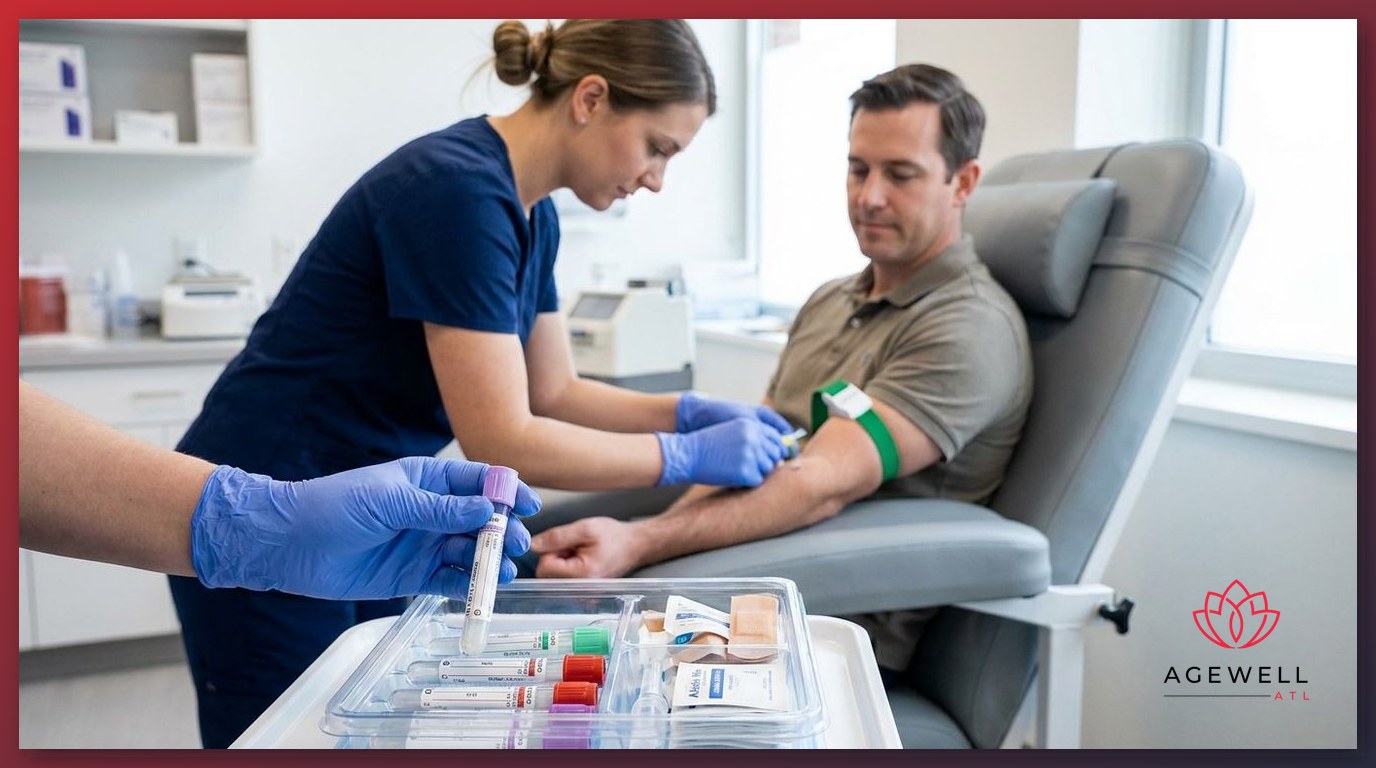
Symptoms such as fatigue, weight gain, and low mood are nonspecific, and low testosterone is frequently misdiagnosed as general aging or depression. The two-morning-draw standard corrects the common misconception that a single low reading is sufficient to diagnose low testosterone: Age Well ATL requires two morning total testosterone measurements below the clinical threshold, typically 300 ng/dL, drawn on separate days before a physician confirms hypogonadism.
The diagnostic panel at Age Well ATL measures total testosterone, free testosterone, LH, FSH, estradiol, SHBG, PSA, hematocrit, and a CBC. The full panel distinguishes primary from secondary hypogonadism and screens for safety risks before a physician writes any prescription.
Contraindications rule out candidacy regardless of lab values: prostate or breast cancer history, untreated severe sleep apnea, and a desire to preserve fertility in the near term. Men concerned about fertility should discuss alternatives such as HCG-based protocols to maintain testicular function before starting TRT, since exogenous testosterone suppresses the hypothalamic-pituitary-gonadal axis and can impair sperm production.
The physician at Age Well ATL interprets every result against the patient’s complete health picture rather than applying a one-size threshold. A man with borderline numbers and severe symptoms may still qualify, while a man with a single low reading and no symptoms does not. Secondary hypogonadism caused by pituitary insufficiency, obesity, or chronic stress can be partially reversible with lifestyle intervention, so the physician evaluation also determines whether TRT is the appropriate first-line recommendation for each patient.
Age Well ATL also operates the Atlanta clinic for women’s hormonal care under a physician-supervised model.
What TRT delivery methods does Age Well ATL offer, and how do they compare?
Testosterone replacement therapy is delivered via injections, topical gels, or pellet implants, with the route selected based on patient lifestyle, preference, and physician assessment. Injections allow dose titration, gels provide steady daily absorption, and pellets release a fixed dose over three to six months.

Injectable testosterone, usually testosterone cypionate or testosterone enanthate, is the most studied delivery form. Patients self-inject once weekly or once every two weeks, and the physician can titrate the dose between appointments as follow-up labs and symptom response come in.
Topical testosterone gels and creams absorb through the skin with once-daily application and produce steady hormone levels without needles. Topical testosterone carries a real transfer risk to female partners and children through skin contact, so patients using gels or creams receive counseling on application sites, hand-washing, and clothing coverage as part of the Age Well ATL program.
Subcutaneous testosterone pellets are inserted beneath the skin every three to six months and provide steady-state hormone delivery that removes daily and weekly compliance demands entirely. Pellets are not adjustable once inserted. The fixed pellet dose is a meaningful tradeoff against injectable protocols, which allow dose titration between appointments.
The choice among these routes is a clinical decision, not patient preference alone. The prescribing physician weighs lifestyle, compliance habits, and early clinical response before recommending a delivery method. The physician perspective on dual hormone therapy documents how clinicians coordinate testosterone with a second hormone when lab panels support combined treatment, and the men’s and women’s hormone protocols outline how dosing routes differ between male and female patients.
How does Age Well ATL monitor patients on TRT, and what safety checks are included?
Age Well ATL monitors TRT patients through scheduled lab panels and physician-reviewed dose adjustments. Physician-supervised TRT includes regular follow-up lab panels monitoring total testosterone, free testosterone, estradiol, hematocrit, and PSA, drawn 6 to 12 weeks after treatment begins and every six months once levels stabilize.

Monitoring follows a fixed sequence. The first follow-up panel occurs 6 to 12 weeks after treatment begins, and the draw confirms testosterone has reached the therapeutic range. The physician then reviews the panel and adjusts dosing based on lab results and symptom response; patients never self-titrate. Men with steady levels and controlled symptoms move to semiannual panels, and every panel rechecks hematocrit and PSA so the physician catches changes early.
Each marker answers a specific safety question. Total and free testosterone confirm the dose is working without overshooting the therapeutic range. Estradiol detects aromatization, the conversion of testosterone into estrogen. Elevated estradiol causes water retention, mood changes, and gynecomastia, and the Age Well ATL physician manages elevated levels within the program rather than leaving patients to manage elevated estrogen alone. PSA screens prostate health throughout therapy.
Hematocrit elevation, called erythrocytosis, is the most common clinically significant TRT side effect, and erythrocytosis produces no symptoms a man can feel at home. Routine blood work catches erythrocytosis before the condition raises clotting risk, which makes lab follow-up a safety requirement rather than a formality and separates physician-supervised programs from unsupervised testosterone use.
TRT for Men: Diagnosis, Treatment & Monitoring explains how diagnosis, delivery selection, and follow-up fit together within the TRT treatment protocols and monitoring schedule, including each lab interval and marker threshold.
How does TRT affect body composition and weight loss for men in Atlanta?
Testosterone optimization supports improved body composition by reducing fat mass and preserving lean muscle, complementing weight loss goals for men with clinically confirmed low testosterone. Most men at Age Well ATL see measurable body composition changes after 3 to 6 months of sustained therapeutic testosterone levels.

Low testosterone creates a hormonal environment that favors fat storage, especially visceral fat around the abdomen, and accelerates lean muscle loss. Clinical evidence describing testosterone’s direct impact on body fat connects low testosterone to a slower metabolic rate. Restoring testosterone to an optimal physiological range shifts the hormonal environment toward lean mass preservation and a healthier metabolic rate. Lean muscle tissue burns more calories at rest than fat tissue, so preserved muscle keeps metabolic rate higher throughout weight loss.
TRT is not a standalone weight-loss treatment. Testosterone therapy works synergistically with nutrition, exercise, and, where appropriate, other physician-supervised interventions. Men on GLP-1 weight loss therapy, peptide protocols, or NAD+ therapy may benefit from hormonal optimization as a complementary intervention, and the Age Well ATL physician coordinates dosing and monitoring across every program.
Body composition changes typically emerge over 3 to 6 months of sustained therapeutic levels, and regular lab work keeps testosterone in the range where those changes happen.
How do Atlanta men get started with TRT at Age Well ATL?
Atlanta men start TRT at Age Well ATL with a physician consultation covering symptoms, health history, and current medications, plus a lab draw that the physician interprets directly. Clinically confirmed low testosterone leads to a personalized, ongoing program with built-in monitoring and dose management.
The process begins with an initial consultation, where the physician reviews the patient’s symptoms, health history, and current medications to determine whether testosterone testing is warranted. Age Well ATL orders bloodwork at or before the consultation, and the physician interprets the results personally rather than relying on a third-party algorithm.
TRT at Age Well ATL is an ongoing physician-supervised program, not a one-time prescription. Age Well ATL hormone and wellness care includes regular check-ins, scheduled lab monitoring, and dose management as built-in parts of treatment.
Age Well ATL is located in Smyrna, GA, serving the broader Atlanta metro area. Men from Marietta, Buckhead, Sandy Springs, and surrounding suburbs can reach Age Well ATL easily for consultations and follow-up visits.