

NAD+ (nicotinamide adenine dinucleotide) is a coenzyme present in every living cell, and NAD+ levels decline measurably with age. Age Well ATL’s physician-supervised NAD+ injection therapy in Atlanta delivers NAD+ by injection to support cellular energy production, cognitive clarity, and normal metabolic function in adults with age-related NAD+ decline. Atlanta adults experiencing fatigue, brain fog, or age-related metabolic slowdown often qualify for NAD+ injection therapy after a physician evaluation.
What is NAD+ and why do levels decline with age?
NAD+ (nicotinamide adenine dinucleotide) is a coenzyme found in every cell of the body, essential for the redox reactions that convert nutrients into ATP energy and for the enzymes that repair DNA. NAD+ declines with age, measurably beginning in the fourth decade of life.

According to a 2023 Oxford University Press study in Innovation in Aging, NAD+ serves as a vital coenzyme in redox reactions and cellular signaling. Elsevier research published on ScienceDirect in 2025 describes NAD+ transporting electrons and hydrogen ions during energy metabolism, with mitochondria using that electron flow to generate the majority of cellular ATP through the electron transport chain. In plain terms, NAD+ is the courier that keeps every cell’s power plant supplied.
NAD+ actually performs two distinct biochemical jobs. First, NAD+ cycles between its NAD+ and NADH forms as a hydride-transfer coenzyme that moves energy through metabolism. Second, sirtuin and PARP enzymes consume NAD+ outright as a substrate during DNA repair and stress response, and a 2012 PLOS ONE study identifies NAD+ as the sole substrate for sirtuin enzymes. That consumption side drives depletion: chronic stress, illness, and aging all raise demand on a finite NAD+ pool, which a 2025 medRxiv paper describes as under constant competition among PARPs, sirtuins, and the enzyme CD38. This dual role of shuttling energy and fueling repair enzymes forms the biochemical basis of NAD+ therapy.
Here is where age enters the picture. A 2020 analysis in Nature Reviews Molecular Cell Biology documents a gradual decline in tissue and cellular NAD+ levels in both rodents and humans, and the 2023 Oxford University Press study identifies increased consumption of NAD+ as the primary driver of that decline in aged tissue. Older adults therefore carry substantially lower NAD+ levels than younger adults. A 2025 review in npj Metabolic Health and Disease notes that healthy cells keep NAD+ production and consumption tightly balanced, and aging disrupts that balance.
When cellular NAD+ runs low, the consequences show up in predictable places:
- Reduced mitochondrial output: cells generate less ATP, so physical and mental energy drop.
- Slower cellular repair: PARP and sirtuin enzymes lose their fuel, and DNA damage accumulates faster than the body can fix.
- Cognitive fog: focus and memory slip as energy-hungry brain tissue competes for scarce NAD+.
- Metabolic sluggishness: 2025 ScienceDirect research ties disrupted NAD+ balance to impaired mitochondrial function and conditions including type 2 diabetes and cardiovascular disease.
Restoring NAD+ levels is the core strategy behind slowing cellular aging with NAD+, because a replenished coenzyme pool keeps sirtuins and PARPs supplied for ongoing DNA repair. The physicians at Age Well ATL build NAD+ injection protocols around exactly this mechanism, replacing what age steadily removes.
How does NAD+ injection therapy work, and how is it different from IV infusions or oral supplements?
NAD+ injection therapy delivers NAD+ subcutaneously or intramuscularly, so the coenzyme enters circulation directly and bypasses the oral bioavailability limits that restrict NMN and NR supplements. IV infusions deliver larger single doses over several hours. Injections take minutes, and NAD+ injections suit frequent outpatient maintenance schedules.
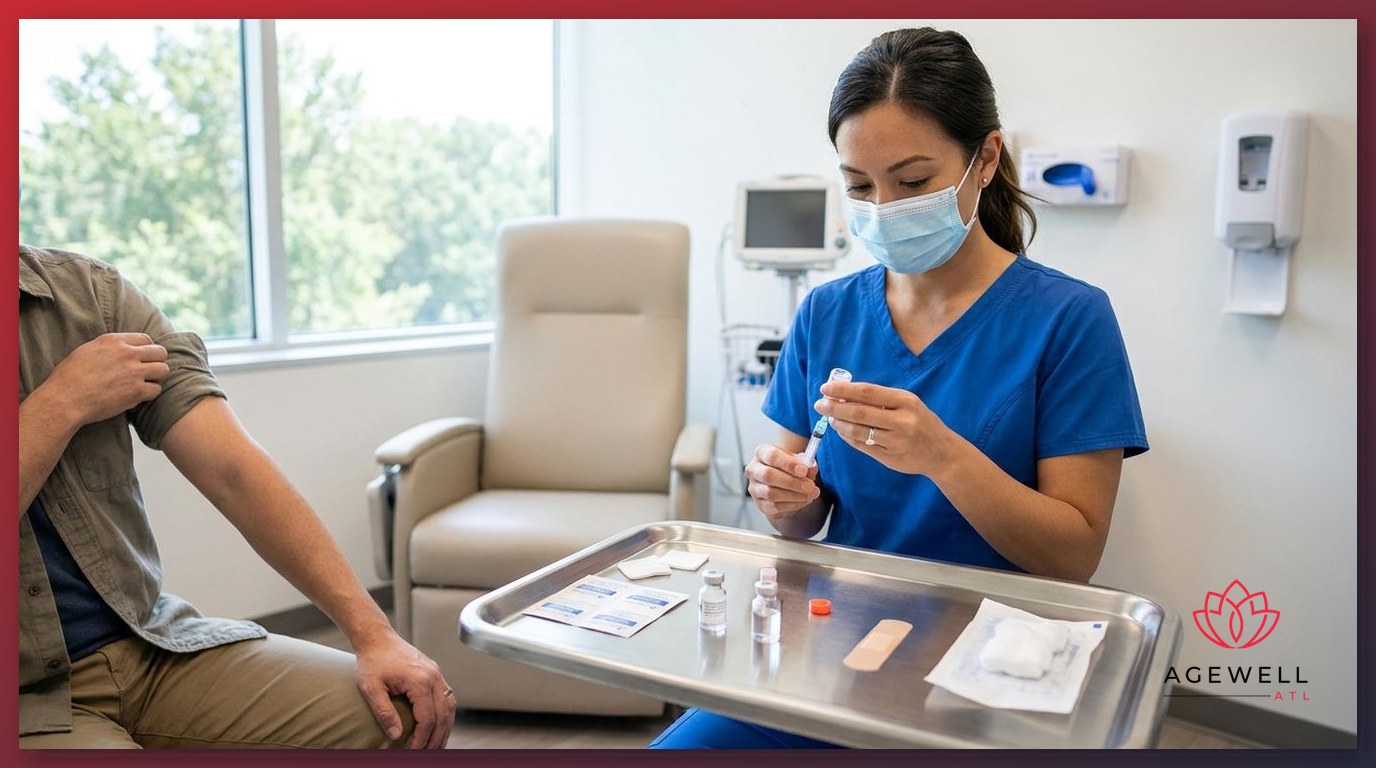
A supervised NAD+ injection program follows four steps:
1. The physician reviews your health history, current medications, and goals, then sets a starting NAD+ dose. 2. A clinician administers the NAD+ by subcutaneous or intramuscular injection during a short outpatient visit. 3. The NAD+ enters the bloodstream intact, with no digestive conversion step required. 4. The physician titrates the dose precisely at follow-up visits and adjusts the schedule based on your response, a level of control over-the-counter supplement regimens cannot match.
Oral NAD+ precursors such as NMN and NR raise NAD+ levels only indirectly, because the gut metabolizes them before they reach target tissues. According to a 2021 Frontiers in Pharmacology review available through PubMed Central, orally administered NR degrades quickly in circulation and shows low bioavailability in targeted organs. Injectable NAD+ skips that conversion entirely, which is why physicians prefer the injection route when a patient needs predictable, rapid repletion rather than gradual precursor-dependent synthesis.
NAD+ injections differ from IV NAD+ infusions in session length, dosing flexibility, and suitability for outpatient maintenance schedules. An IV infusion delivers a higher dose in one session but keeps you in a clinic chair for several hours, and some patients feel transient nausea or chest tightness during rapid infusion. Injections use lower per-session volumes, so they typically produce a milder side-effect profile and suit patients who found IV infusions uncomfortable. Patients choosing between NAD+ injection and IV therapy weigh per-session dose against time commitment, and some Atlanta providers offer IV drip delivery to your Atlanta door for those who want infusion-level dosing without the commute.
What benefits can NAD+ injection therapy provide for energy, focus, and anti-aging?
NAD+ injection therapy restores cellular energy, sharpens focus and mental clarity, and supports anti-aging at the cellular level. Replenished NAD+ improves mitochondrial ATP production, fuels neuronal energy metabolism, and activates sirtuins that drive DNA damage repair and longevity signaling.

Restored mitochondrial NAD+ levels support more efficient ATP synthesis, reducing fatigue in adults with functional energy deficits. Supervised NAD+ replenishment targets these deficits directly rather than masking them with stimulants.
For cognition, NAD+ supports neuronal energy metabolism and neuroprotective sirtuin signaling, and patients report improved mental clarity and working memory. The NAD+ therapy mental clarity outcomes detail these reported gains across supervised treatment courses.
NAD+ is required by sirtuins for DNA repair and longevity signaling. Sirtuin activation drives DNA damage repair and mitochondrial biogenesis, two processes central to cellular longevity research. This sirtuin biology underpins NAD+ anti-aging support, and Age Well ATL applies the same science through anti-aging longevity and wellness programs supervised by physicians.
Patients seeking broader longevity support often add NAD+ complementary anti-aging peptides to a supervised protocol.
Can NAD+ therapy support addiction recovery?
Yes, NAD+ therapy can support addiction recovery as a neurological adjunct. Addiction recovery programs use NAD+ therapy to reduce withdrawal-associated cravings and support neurological repair, because NAD+ plays a direct role in the brain’s dopamine reward pathways. NAD+ therapy complements medical detox and behavioral treatment rather than replacing either one.

Some clinical recovery programs administer high-dose NAD+ protocols to accelerate neurological repair after substance exposure. Prolonged substance use disrupts cellular energy metabolism in brain cells, and restoring NAD+ levels supports mitochondrial function during early abstinence. For many patients in active recovery, this cellular support is the specific role NAD+ therapy fills within a broader treatment plan.
NAD+ therapy is an adjunct. NAD+ therapy does not replace medical detox, psychiatric care, or behavioral therapy, and each of those remains the foundation of a successful recovery. A physician at Age Well ATL reviews each patient’s health history and current treatment plan before recommending NAD+ injections, so the therapy fits safely alongside supervised care.
How does Age Well ATL’s NAD+ injection program work, and who is a good candidate?
Age Well ATL administers NAD+ injections under physician supervision at its Smyrna, GA clinic serving the Atlanta metro. A physician designs each patient’s dosing protocol, and strong candidates include adults 35 and older with fatigue, cognitive complaints, longevity goals, or supervised addiction recovery.
The physician-supervised NAD+ program at Age Well ATL includes intake evaluation, lab assessment, individualized dosing protocol, and progress monitoring.
1. Intake evaluation. A physician reviews health history, symptoms, and treatment goals. Where indicated, lab assessment establishes baseline NAD+ status and rules out contraindications before the first injection. 2. Individualized injection protocol. The physician calibrates frequency, dose, and duration to the patient’s goals, whether the priority is energy, cognition, anti-aging support, or recovery support. 3. Progress monitoring. The physician tracks response across follow-up visits and adjusts dosing as goals evolve, so the plan grows with the patient.
Adults 35 and older with persistent low energy, brain fog, or healthy-aging goals are strong candidates, as are adults in active addiction recovery whose NAD+ therapy sits inside a broader medically supervised plan. The Atlanta integrative wellness center brings these services together under physician oversight for patients with overlapping goals.
Candidacy has limits. Physician screening identifies patients who should not proceed without specialist clearance for specific active health conditions. Adults with active malignancies should discuss risks with their oncologist first, because NAD+ supports cell proliferation pathways that are also active in tumor cells. Screening exists to catch exactly these edge cases before treatment starts.
Age Well ATL is located in Smyrna, GA and serves adults across the greater Atlanta metro, including Marietta, Buckhead, Sandy Springs, and surrounding communities. The physician-supervised medical weight loss and wellness in Atlanta program supports patients whose goals extend beyond NAD+ therapy, and NAD+ injection therapy in Atlanta follows expected benefit and treatment timelines.