

Melanotan II is a synthetic melanocortin peptide that activates several melanocortin receptors at once, producing UV-independent skin darkening, enhanced libido, and reduced appetite. Because Melanotan II influences tanning, sexual function, and weight management at the same time, this advanced compound requires careful dosing and ongoing medical oversight. At Age Well ATL in Smyrna, physicians supervise every Melanotan II treatment plan, giving Atlanta-area patients the clinical monitoring this peptide demands.
What is Melanotan II and how does it work?
Melanotan II is a synthetic analog of alpha-melanocyte-stimulating hormone (α-MSH), the natural hormone that regulates pigmentation, energy balance, and sexual function. Melanotan II activates MC1R, MC3R, and MC4R melanocortin receptors to produce tanning, appetite suppression, and libido effects respectively. Patients administer Melanotan II by subcutaneous injection.
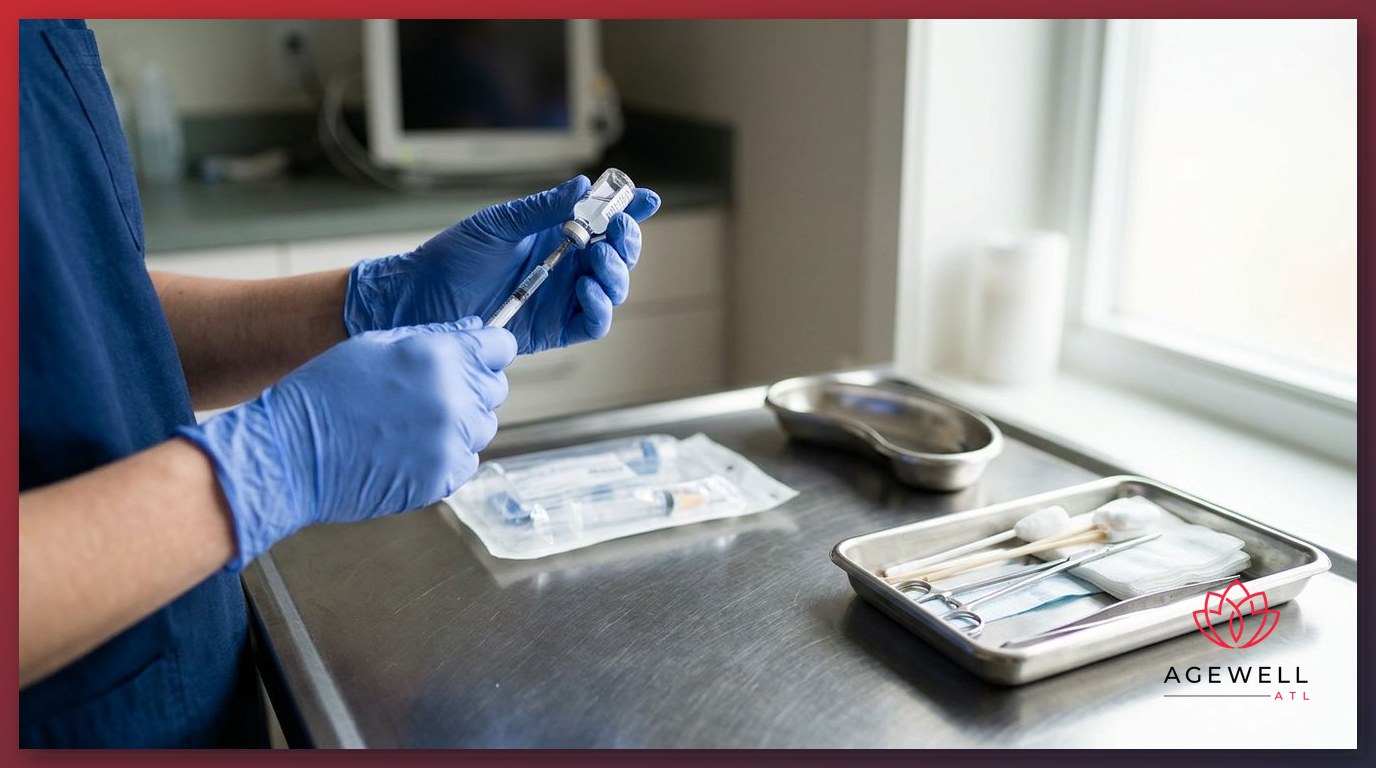
Melanotan II is not a natural hormone. A 2020 National Institutes of Health publication describes Melanotan II as a synthetic cyclic heptapeptide analogue of α-MSH and, as a non-selective agonist of melanocortin receptors, more potent and stable than the endogenous α-MSH the body produces. Chemists engineered the cyclic structure to resist rapid enzymatic breakdown, so each dose sustains receptor activation longer than natural α-MSH can.
Melanotan II binds three melanocortin receptor subtypes, and each receptor drives a distinct clinical effect:
- MC1R (melanocortin 1 receptor): located on skin melanocytes, MC1R stimulates melanin production and darkens skin without ultraviolet exposure.
- MC3R (melanocortin 3 receptor): MC3R regulates appetite and energy balance, and MC3R activation reduces hunger signaling.
- MC4R (melanocortin 4 receptor): MC4R governs libido and satiety pathways, and MC4R activation increases sexual arousal while reinforcing fullness.
Because one molecule engages all three receptors, a single Melanotan II protocol produces three simultaneous clinical applications: pigmentation, libido enhancement, and appetite modulation. U.S. Patent and Trademark Office records describe Melanotan II as a non-selective agonist at MC-1R, MC-3R, MC-4R, and MC-5R, extending the peptide’s receptor activity beyond the three primary pathways. Broad receptor activity distinguishes Melanotan II from single-mechanism peptides, which engage one receptor and deliver one primary effect.
Melanotan II is not the same compound as Melanotan I (afamelanotide). The two peptides differ in receptor selectivity and clinical profile, and only Melanotan II produces the combined tanning, libido, and appetite effect through broader melanocortin receptor binding.
Administration follows peptide pharmacology. Patients inject Melanotan II subcutaneously into the fatty tissue of the abdomen or thigh, since digestive enzymes break peptide bonds before an oral dose can reach the bloodstream. Adults researching what Melanotan II is and does often expect a simple tanning compound and discover a multi-system peptide with three clinical pathways.
How does Melanotan II produce a tan without heavy sun exposure?
Melanotan II produces a tan by activating melanocortin 1 receptors (MC1R) on melanocytes, the skin’s pigment cells. MC1R activation stimulates endogenous melanin production, so the tanning cascade begins before sunlight reaches the skin and pigmentation develops without heavy UV exposure.

The Melanotan II tanning effect is caused by MC1R activation increasing melanin production without requiring UV exposure to trigger the cascade. The process unfolds in four steps:
1. Melanotan II binds MC1R receptors on the surface of melanocytes across the skin. 2. MC1R activation signals melanocytes to synthesize eumelanin, the brown-black pigment behind skin darkening. 3. Melanin accumulates in the skin and produces visible pigmentation independent of sun exposure. According to the U.S. Patent & Trademark Office, MC1R agonists also protect the skin by enhancing repair of UV-induced DNA damage. 4. Minimal UV exposure deepens the tan, but sunlight is not required to start pigmentation.
This mechanism corrects a common misconception. Melanotan II does not simply boost a traditional tan. The peptide increases melanin synthesis endogenously, so even minimal sun exposure produces a deeper, faster tan than UV alone could achieve.
That distinction matters for our fair-skinned neighbors. Patients with fair or light skin who historically burn easily may achieve a tan that UV exposure alone cannot produce, because the melanin signal comes from the peptide rather than from sun damage.
Results still vary by skin type and baseline melanin levels, so a physician assesses candidacy before treatment begins. At Age Well ATL, the melanotan and longevity peptide options start with a physician review of skin type and pigmentation history as part of supervised care.
Can Melanotan II improve libido and sexual function?
Yes. Melanotan II improves libido and sexual function through MC4R activation in the central nervous system, which influences sexual arousal pathways in both men and women. Clinical research documents increased sexual desire and improved erectile response following Melanotan II administration.

The evidence spans both sexes. According to a 2022 randomized, double-blind, placebo-controlled crossover study in the Journal of Clinical Investigation, MC4R agonism produced a statistically significant increase in participant-reported sexual desire versus placebo for up to 24 hours after administration in women with hypoactive sexual desire disorder. A home-monitoring study indexed by ScienceDirect recorded erections in 17 out of 20 men with erectile dysfunction, alongside increased sexual desire. These findings support Melanotan II for patients of either sex experiencing low libido as a clinical concern.
The Melanotan II libido effect is centrally mediated, meaning the peptide acts on brain arousal pathways rather than raising testosterone or altering estrogen. A 2003 review in the Annals of the New York Academy of Sciences identifies melanocortin receptors MC3R and MC4R as expressed primarily in the central nervous system, which explains why this mechanism differs from hormone-based interventions. Patients with normal hormone panels can still respond.
Low libido has many possible drivers, including hormonal shifts, medications, stress, and relationship factors. A physician evaluation determines whether Melanotan II is appropriate relative to hormonal or other causes before any protocol begins. The peptide therapy for low libido starts with that diagnostic step, matching each patient to the treatment that addresses the actual cause of low desire.
Does Melanotan II suppress appetite and support weight loss?
Yes. Melanotan II suppresses appetite by activating MC3R and MC4R receptors in the hypothalamus, the brain region that governs energy balance and satiety signaling. This central mechanism supports weight management as one tool within a physician-supervised program, never as a standalone therapy.

MC3R and MC4R activation in the hypothalamus causes Melanotan II appetite suppression by modulating energy balance and satiety signaling. According to PubMed and National Institutes of Health research, MC4R in the paraventricular nucleus of the hypothalamus plays a central role in appetite regulation, with POMC and AgRP neurons acting antagonistically at downstream MC4R to regulate homeostatic satiety. In plain terms, Melanotan II signals the brain’s own fullness circuitry rather than the stomach.
This pathway is mechanistically distinct from GLP-1 receptor agonist pathways. GLP-1 receptor agonists act peripherally on gut hormone signaling, while Melanotan II acts centrally through hypothalamic receptors. That difference matters clinically. A supervised program can use Melanotan II as a genuinely different lever rather than a redundant copy of GLP-1 weight-loss therapy.
Within a physician-supervised weight management program, appetite suppression from Melanotan II complements nutrition planning, activity guidance, and other peptide therapies as one tool among several. Melanotan II is not a standalone weight-loss therapy, and clinical outcomes depend on program integration and lifestyle factors. The melantan and peptide clinic Atlanta outlines how the clinic pairs Melanotan II with broader metabolic support under physician monitoring.
Why should Melanotan II be administered under physician supervision in Atlanta?
Melanotan II requires physician supervision for safe use due to its potent multi-receptor activity and individual variability in response. Age Well ATL delivers Melanotan II as part of a physician-supervised peptide protocol that includes candidacy evaluation, dosing guidance, and ongoing monitoring.
Physician supervision is not merely a legal formality for Melanotan II. The peptide is not FDA-approved for cosmetic use, so physician oversight serves as the primary safety mechanism for patients using Melanotan II outside traditional approval channels. Because Melanotan II activates several melanocortin receptor subtypes at once, side effects can reach multiple systems simultaneously. U.S. Patent & Trademark Office records link the restricted commercial development of Melanotan II for sunless tanning to off-target effects including spontaneous erections lasting 1 to 5 hours, nausea, grade II somnolence, fatigue, stretching, yawning, and loss of appetite from undesired MC3R and MC4R activation. Physician oversight allows proactive dose titration around these reactions, while unmonitored self-dosing leaves nausea, facial flushing, darkening of existing moles, and spontaneous erections in men unmanaged.
A candidacy evaluation at Age Well ATL assesses skin type, sexual health history, weight goals, and existing conditions before any protocol begins. Patients with a history of melanoma or atypical moles are generally not candidates, because MC1R stimulation of melanocytes requires physician review of skin history first. Men receive counseling that spontaneous erections are a documented MC4R-mediated side effect at higher doses, and supervised titration minimizes that risk by starting at the lowest effective dose.
During treatment, our physicians monitor mole changes, nausea patterns, cardiovascular response, and other receptor-mediated effects at every visit. Age Well ATL is the doctor-supervised treatment hub Atlanta patients turn to for these monitored programs, located in Smyrna, GA and serving the greater Atlanta metro. Getting started with the peptide-based healing services Atlanta residents receive at Age Well ATL begins with an initial consultation, not self-directed dosing from unregulated sources.